
The Tech Gold Rush in the Lone Star State
The economic reality facing mid-market companies and fast-growth startups across Texas is hyper-competitive. From the SaaS ecosystems of Austin to the sprawling enterprise operations of Houston and Dallas-Fort Worth, customer acquisition and retention cycles have tightened. Consumer attention lives exclusively within the handheld screen.
The Problem
Many brands try to manage digital customer interactions using fragmented legacy web tech, sluggish hybrid templates, or disjointed third-party software as a service (SaaS) extension.
The Agitation
These disconnected systems increase customer drop-off, complicate user onboarding, and create data silos that make scaling operations painful. If your mobile customer portal feels slow, experiences system crashes, or requires users to navigate an unoptimized web wrapper, your customers will migrate to a competitor who offers a smooth, responsive native experience.
The Solution
Investing in professional custom mobile app development Texas addresses these bottlenecks directly. Developing bespoke mobile products transforms the smartphone interface from a simple communication point into a high-converting revenue driver and highly efficient operational ecosystem.
Why Standard App Templates Risk Corporate Growth
Off-the-shelf app templates and low-code builders are tempting options for keeping upfront costs low. However, relying on fixed software environments can fundamentally limit long-term corporate growth.
Expert Explanation
Standard, pre-built application templates rely on generic, monolithic codebases designed to satisfy the absolute lowest common denominator of business operations. They use bloated, universal plugins to offer wide-ranging but shallow functionality. This layout introduces significant technical debt (the future cost of reworking rushed or unoptimized code) the exact moment you need to alter database routing structures, customize user permissions, or integrate proprietary logistics software.
Practical Comparative Matrix
| Feature Set | Off-the-Shelf App Templates | Custom Mobile App Development |
| Initial Capital Expense | Low entry barrier | Higher upfront capitalization |
| Source Code Equity | Zero ownership; leased environment | 100% intellectual property ownership |
| Scaling Flexibility | Hard ceilings dictated by parent platforms | Infinite; modular microservices architecture |
| API Integration Cap | Strict sandbox constraints | Universal; custom middleware and endpoint connectivity |
| Security Architecture | Shared, public vulnerability footprints | Isolated, zero-trust enterprise security layers |
Business Benefits & Real-World Use Case
Consider a regional medical supply company operating out of San Antonio. Using a generic e-commerce app template might help them launch a basic digital catalog within weeks. However, when they need to sync real-time inventory systems with hospital procurement software, ensure complete HIPAA data compliance, and enable automated re-ordering pipelines based on barcode scanning, template apps become completely unusable.
By pivoting to customized business mobile app development, the enterprise can build a direct connection into their specific inventory databases. This integration eliminates manual manual processing errors and creates a secure, compliant supply chain.
The Core Architectural Split: iOS vs. Android vs. Cross-Platform
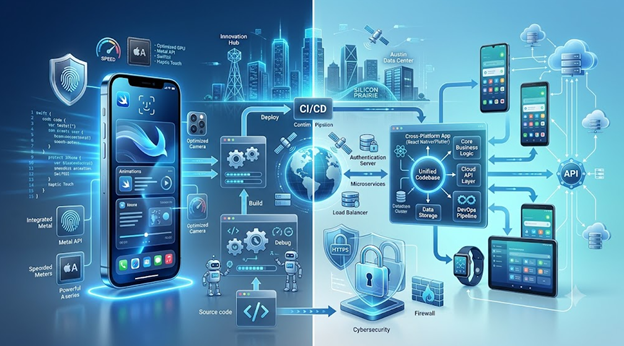
A critical technical decision when launching a mobile product is selecting the appropriate underlying framework architecture. Choosing wrong can dramatically impact your timeline and development budget.
Expert Explanation
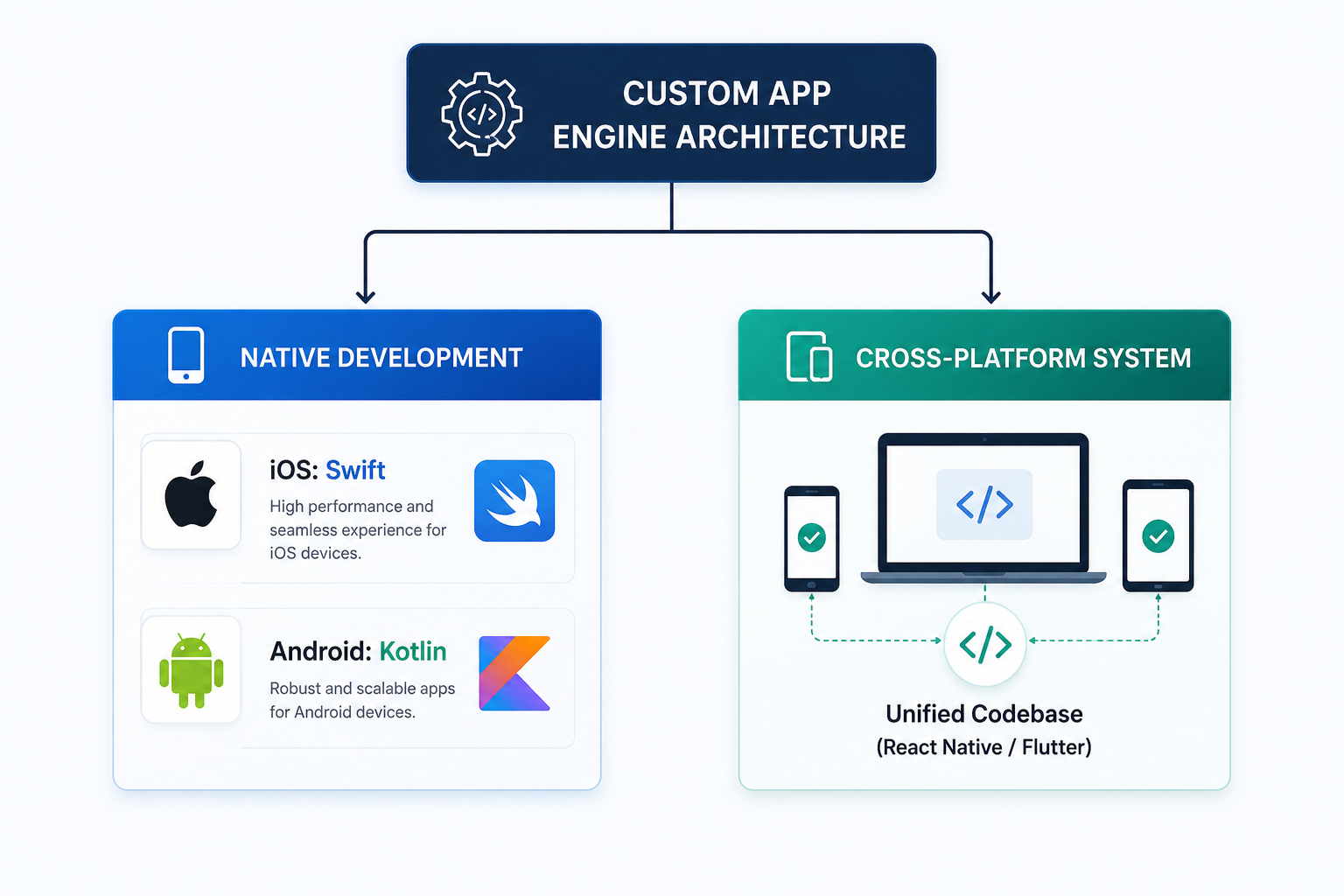
Engineering divisions split mobile platforms into two distinct methodologies: Native Development and Cross-Platform Frameworks.
- Native Development involves writing completely independent applications for each operating system using their respective primary language stacks—Swift or Objective-C for iOS app development Texas, and Kotlin or Java for android app development Texas. This grants direct access to device hardware, maximizes computational processing speeds, and aligns with native operating system user interface rules.
- Cross-Platform Frameworks utilize singular codebases written in frameworks like Flutter (Dart) or React Native (JavaScript) that compile down into native components. This allows a single team of mobile app developers Texas to build, update, and deploy software across both platforms simultaneously.
Actionable Strategic Insights
- Choose Native Development if: Your mobile app requires high computational processing, complex multi-threaded background operations, intensive real-time camera rendering, or direct biometric data handling.
- Choose Cross-Platform Frameworks if: You need to validate a Minimum Viable Product (MVP) across both major operating platforms quickly, your feature set relies primarily on database CRUD (Create, Read, Update, Delete) operations, and you want to lower long-term application maintenance budgets by managing a single codebase.
Step-by-Step Breakdown of a Custom App Engineering Lifecycle
Building a reliable enterprise app requires following a structured, milestone-driven software development lifecycle (SDLC). The following timeline outlines the development phases, resource allocation, and key deliverables from initial planning through launch.
1: Discovery Framework & Semantic Mapping
Weeks 1 – 2.
Engineers and product analysts map user user paths, isolate required API endpoints, define core functional parameters, and establish security guidelines. This phase eliminates guesswork and ensures technical alignment before writing code.
2: UI/UX Prototyping & Wireframing
Weeks 3 – 6
Design teams build highly detailed user flows and wireframes. These interactive prototypes let you review user interactions and test layout logic before starting backend engineering.
3: Core Sprint Coding & Backend Engineering
Weeks 7 – 16.
Developers build the application infrastructure using agile methodology. Frontend teams implement the visual designs while backend teams deploy secure cloud systems, assemble microservices, and connect required database schemas.
4: Rigorous Quality Assurance & Device Testing
Weeks 17 – 20.
QA engineers run comprehensive automated and manual testing suites across physical device labs. Testing covers performance benchmarks, network stress conditions, security vulnerabilities, and regression testing across different OS versions.
5: App Store Deployment & Monitoring
Week 21+
DevOps teams handle the compilation, signing, and submission processes for the Apple App Store and Google Play Store. Post-launch, monitoring platforms continuously track system performance, crash logs, and user retention metrics.
Quantifying the ROI of Custom Business Infrastructure
For corporate finance teams and stakeholders, a custom mobile app is an investment that needs to justify its budget through clear financial returns and operational improvements.
Real-World Industrial Metrics
- Operational Expense Mitigation: Replacing manual field service reports with a custom utility app that logs asset metrics automatically can reduce administrative overhead by up to 35%.
- Customer Lifetime Value Multipliers: Direct, personalized push notifications based on past purchasing behavior convert at a 4x higher rate than generic email marketing campaigns.
- Platform Value: Building unique software assets directly increases your company’s balance sheet valuation, turning an operational expense into long-term intellectual property equity.
Key Performance Indicator Target: When analyzing enterprise mobile projects, target a full return on your initial development investment within 14 to 18 months of deployment by automating internal operations or capturing new digital sales channels.
Why Proximity Matters: Partnering with a Texas-Native Agency
While global outsourcing platforms can seem attractive on paper due to low hourly rates, the hidden costs of massive time-zone differences, cultural gaps, and misaligned quality standards frequently stall complex projects. Partnering with a dedicated onshore mobile app development company Texas keeps your development team directly connected to your operational reality.
Real-World Collaboration Benefits
- Same-Zone Agility: Conducting design sprints and standups in Central Standard Time (CST) allows for real-time collaboration without delayed communication loops.
- Regulatory Alignment: Texas-based development agencies design your application architecture with full awareness of local compliance frameworks, regional privacy laws, and specific industry requirements.
- Collaborative Design Labs: Developing complex custom products benefits heavily from interactive planning sessions. Working with a domestic team means you can easily meet for in-person product workshops to flesh out your product vision.
At Designix INC, we pair modern engineering capabilities with the local accessibility Texas businesses need to build high-performance mobile software. We avoid generic templates and bloated frameworks to focus on delivering clean code, reliable backend architecture, and highly polished user experiences built to grow with your business.