
Choosing an AI consulting partner is a major business decision. The right partner can help your company automate repetitive work, improve decision-making, and build practical AI solutions. The wrong one can leave you with expensive software, complicated systems, and little measurable value.
The challenge is that many AI consultants promise impressive results, but not every business needs advanced AI, custom models, or a complete digital transformation.
The smartest way to choose an AI consulting company is to evaluate its business understanding, technical expertise, project transparency, security practices, and ability to prove return on investment (ROI).
This guide explains how to vet an AI consulting partner, recognize warning signs, compare different service providers, and avoid spending your budget on AI projects that don’t solve real problems.
What Are AI Consulting Services?
AI consulting services help businesses identify, plan, develop, and implement artificial intelligence solutions that address specific business challenges.
An AI consultant connects business objectives with suitable technologies, helping organizations decide what to automate, which AI tools to use, and how to measure the results.
Common AI consulting services include:
- AI strategy and readiness assessments
- Custom AI development and integration
- AI agents and workflow automation
- Generative AI solutions and business chatbots
- Machine learning and predictive analytics
- AI-powered customer support
- Enterprise AI implementation and optimization
For example, a company receiving hundreds of customer inquiries every day might hire an AI consultant to build a support assistant that answers common questions, retrieves approved information, and forwards complicated requests to human staff.
The objective isn’t simply to introduce AI. It’s to solve a business problem in a practical, measurable way.
Why Choosing the Wrong AI Consulting Partner Can Waste Your Budget
An AI project can become expensive when a consultant recommends technology before understanding the problem it needs to solve.
Businesses may end up paying for custom development when an existing tool would have worked, automating a process that should have been redesigned first, or building a system that employees rarely use.
Common reasons AI projects waste money
- Unclear objectives: The project begins with a vague goal such as “make our business AI-powered.”
- Overengineering: The consultant proposes complex custom technology for a relatively simple task.
- Hidden costs: Licensing, integrations, cloud infrastructure, maintenance, and support aren’t included in the original estimate.
- Poor data quality: The AI system relies on incomplete, outdated, or inconsistent information.
- No adoption plan: Employees don’t receive the training or support needed to use the solution.
- Unmeasured results: The company cannot determine whether the AI implementation actually improved performance.
A reliable partner should help you avoid these problems before development begins not simply explain them after your budget has been spent.
1. Start With the Business Problem, Not the AI Technology
The first step in vetting an AI consulting partner is checking whether they understand your business challenge before recommending a solution.
A consultant should ask about your current workflow, operational bottlenecks, existing systems, employees, customers, and expected outcomes.
If the conversation immediately turns into a sales pitch for AI agents, generative AI, or custom machine learning, ask how that technology addresses your specific problem.
Questions to ask
- Which business process are we trying to improve?
- Why is the current process underperforming?
- Could conventional software or process improvement solve the problem?
- What information and systems would the AI need?
- How will we measure success?
Real-life example:
Imagine an e-commerce company with a five-person customer support team. Management believes AI could reduce support costs and asks an AI consulting firm to automate customer service.
A weak consultant immediately proposes an expensive, fully autonomous AI agent.
A more thoughtful consultant first reviews the support team’s workload and discovers that a large share of inquiries involve order tracking, return policies, and product availability.
Instead of automating every interaction, the consultant proposes a limited solution that retrieves order information, answers approved FAQs, and routes sensitive or complicated cases to human representatives.
The difference is that the project begins with an operational problem rather than a technology trend.
2. Check Whether the AI Consultant Has Relevant Experience

An AI consulting company should be able to demonstrate that it understands the type of challenge you’re trying to solve.
A long list of AI technologies on a website doesn’t necessarily prove that the company can deliver a successful business implementation.
Look for experience that matches your industry, workflow, technical environment, or project complexity.
What to examine in its portfolio
- Relevant AI projects and their business objectives
- Technologies and integrations used
- The consultant’s actual role in the project
- Implementation challenges and how they were addressed
- Measurable results, where available
- Ongoing maintenance and post-launch improvements
Ask the company to walk you through a completed project from beginning to end.
A credible consultant should be able to explain what the client needed, why a particular solution was selected, what limitations existed, and how the outcome was evaluated.
Don’t confuse a demo with a proven implementation
A chatbot demonstration can show that a technology works under controlled conditions. It doesn’t necessarily prove that the system can handle real customer data, unexpected requests, security requirements, or business-critical workflows.
Ask for evidence of how the solution performed outside the demo environment, while respecting client confidentiality.
3. Evaluate the Proposed AI Strategy Before Approving Development
A good AI consulting partner should explain how the project will move from the initial business problem to a working solution.
The strategy should include a realistic scope, technical approach, data requirements, implementation stages, and measurable success criteria.
A practical AI project roadmap
- Discovery and business assessment
Understand the workflow, objectives, existing systems, and operational challenges.
- Feasibility and data assessment
Check whether the required data, technology, integrations, and resources are available.
- Proof of concept (PoC)
Test the core idea on a limited scale before committing to a full implementation.
- Pilot implementation
Deploy the solution with a controlled group of users or a limited business process.
- Testing and deployment
Evaluate performance, security, reliability, user experience, and integration quality.
- Monitoring and optimization
Track outcomes, address failures, manage ongoing costs, and improve the system.
This approach helps your business identify problems early, before they become expensive development issues.
A consultant should also explain which stages are included in the proposal and which require separate approval or payment.
4. Understand the Full Cost of AI Consulting Services
The quoted development fee is only one part of the total cost of an AI implementation.
Your business may also need to pay for software subscriptions, model usage, cloud infrastructure, data preparation, integrations, security assessments, employee training, and ongoing support.
AI consulting costs you should clarify
| Cost category | What to ask |
| Consulting | Are discovery, strategy, and project planning included? |
| Development | What features and deliverables are covered? |
| AI usage | Are model, API, or token charges billed separately? |
| Infrastructure | Who pays for hosting, storage, and cloud services? |
| Integration | Are existing software connections included? |
| Maintenance | What support and updates are covered after launch? |
| Training | Are employee onboarding and documentation included? |
Example: A seemingly affordable AI project
Suppose a fictional consulting firm quotes a business $15,000 to develop an AI-powered internal knowledge assistant.
The initial proposal sounds manageable, but the business later discovers that hosting, document preparation, software licenses, and ongoing maintenance are billed separately.
The total cost of ownership could be significantly higher than the original development quote.
This example is illustrative, not a market price estimate. The lesson is to request a complete cost breakdown before signing a contract.
Ask for a 12-month total cost estimate, including expected usage, recurring fees, maintenance, and potential scaling costs.
5. Compare Custom AI Development vs. Ready-Made AI Tools
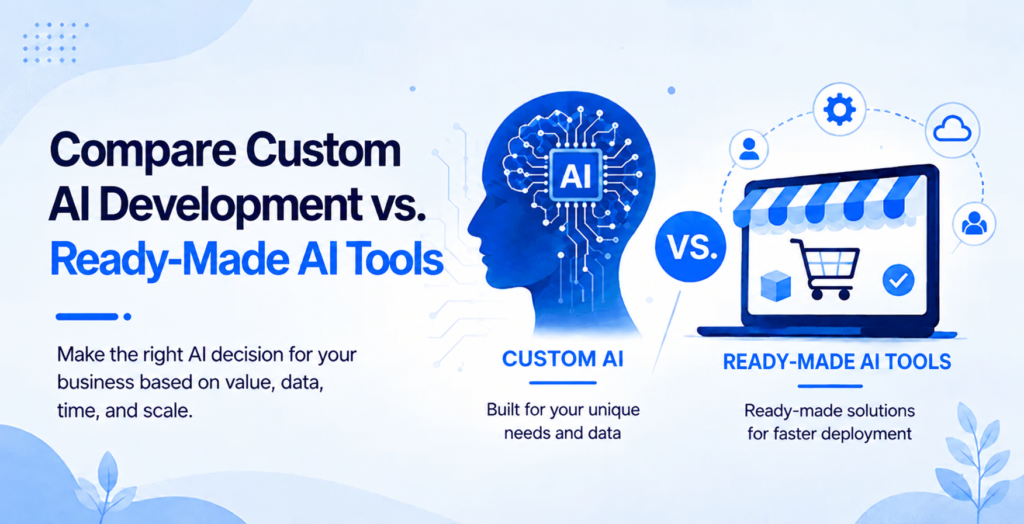
Not every business needs a custom AI solution. A trustworthy consultant should explain whether existing tools can meet your requirements before recommending a more expensive development project.
The right choice depends on your workflow, data, integration needs, security requirements, and long-term plans.
Ready-made AI tools
Best suited to common business needs
Existing AI platforms can help businesses introduce capabilities such as content assistance, customer support, document processing, and productivity automation without building everything from scratch.
Advantages: Faster setup, established features, and potentially lower initial development costs.
Limitations: Subscription costs, vendor restrictions, and less flexibility for specialized workflows.
Custom AI development
Best suited to specialized requirements
Custom solutions can be designed around proprietary workflows, unique data structures, complex integrations, or business-specific requirements.
Advantages: Greater control over functionality, integration, and system design.
Limitations: More development effort, testing, maintenance, and potentially higher ongoing costs.
Which approach should you choose?
Consider a small business that wants to summarize meeting notes. An existing AI productivity tool may already provide the necessary functionality.
Now consider a logistics company that needs to combine data from several internal systems to support a specialized operational workflow. A customized integration may be more appropriate.
Neither option is automatically better. Your consultant should explain the trade-offs and provide a business-based reason for the recommendation.
6. Ask How the Consultant Protects Your Business Data

AI implementation can involve sensitive customer information, employee records, internal documents, and confidential business data.
Before sharing information or connecting AI tools to company systems, understand how the consultant will protect it.
Essential security questions
- Where will our data be stored and processed?
- Who can access our information?
- Will our data be used to train an AI model?
- How are permissions and access controls managed?
- What happens to our data when the contract ends?
- How are security incidents reported and handled?
- What safeguards prevent unauthorized actions by AI agents?
Also ask how the consultant will address data retention, third-party AI providers, and applicable privacy obligations.
For AI agents that can send emails, modify records, or trigger transactions, require appropriate access restrictions, testing, and human approval for sensitive actions.
A consultant should be able to explain these safeguards in clear language, not just use technical terminology to avoid answering your questions.
7. Make Sure the Consultant Defines Measurable ROI

A successful AI project should deliver a measurable business outcome not simply a functioning chatbot or an impressive demonstration.
Before development begins, agree on the baseline performance and the metrics you’ll use to evaluate the solution.
Examples of useful AI project KPIs
| Business objective | Possible KPI |
| Reduce customer support workload | Average handling time |
| Improve response speed | First-response time |
| Automate document processing | Hours spent per document |
| Improve lead management | Lead response time |
| Reduce manual data entry | Manual processing hours |
| Improve service quality | Error rate or customer satisfaction |
Real-life-style example: Measuring support automation
A fictional online retailer spends 200 staff hours each month handling routine customer questions.
It introduces an AI assistant to handle selected inquiries, while keeping human agents responsible for complex cases.
Instead of declaring success because the chatbot is live, the retailer measures:
- How many inquiries are resolved correctly?
- How many cases still require human intervention?
- How much staff time is saved?
- Does customer satisfaction remain acceptable?
- What are the AI system’s operating costs?
The business can then compare the measured savings and benefits against the implementation and operating costs.
This is how an AI consultant should approach ROI: establish a baseline, measure actual performance, and acknowledge costs and limitations.
8. Review the Contract, Deliverables, and Ownership Terms

A clear contract protects both your business and the consulting partner by defining expectations before work begins.
Don’t approve a proposal that describes the project only as “AI implementation” without specifying what you’ll receive.
Your agreement should clarify
- Project scope and milestones
- Deliverables and acceptance criteria
- Payment schedule and change-request process
- Responsibility for third-party subscriptions
- Ownership of custom code and project documentation
- Data access, confidentiality, and deletion procedures
- Warranty, maintenance, and support arrangements
- Exit terms and transition assistance
Pay particular attention to ownership. Determine whether your business will receive the source code, configuration files, documentation, and necessary access credentials or whether the solution depends on the consultant’s proprietary platform.
You should also understand what happens if the engagement ends or you decide to work with another provider.
9. Watch for These AI Consulting Red Flags

A consultant’s sales pitch can sound convincing while leaving important project risks unanswered.
Look for warning signs during the discovery process, proposal review, and contract negotiations.
⚠Guaranteed business results
Be cautious of promises of guaranteed revenue growth, perfect accuracy, or a specific ROI without understanding your data and operations.
⚠No clear project scope
Vague deliverables make it difficult to control costs, measure progress, or determine whether the project is complete.
⚠ Pressure to commit immediately
A legitimate project should allow time for due diligence, security reviews, and contract evaluation.
⚠ No discussion of failure cases
Ask how the system handles incorrect outputs, unavailable services, unexpected inputs, and situations requiring human intervention.
⚠ No post-launch plan
AI systems require monitoring, maintenance, and evaluation. Find out who will manage these responsibilities.
One red flag doesn’t automatically prove a consultant is unqualified, but it signals an issue that deserves clarification before you commit your budget.
10. Use This Checklist Before Hiring an AI Consulting Partner
Use this practical checklist to organize your evaluation before signing a contract.
AI Consultant Evaluation Checklist
- The consultant understands our business problem.
- The proposed solution has a clear business justification.
- Relevant experience and project examples have been reviewed.
- The project scope, milestones, and deliverables are documented.
- The total implementation and ongoing costs are transparent.
- Data security and privacy requirements are addressed.
- Success metrics and ROI measurement are agreed upon.
- Ownership, maintenance, and support terms are clear.
- A pilot or proof of concept is considered where appropriate.
- The project includes testing, employee adoption, and monitoring.
Final Thoughts: Choose an AI Partner That Protects Your Budget
Finding the right AI consulting partner isn’t about choosing the company with the most impressive technology or the biggest list of AI services.
It’s about finding a partner who understands your business, recommends an appropriate solution, communicates costs clearly, protects your data, and measures results against realistic objectives.
Start with a specific business problem. Compare custom development with existing tools. Request a transparent roadmap, evaluate relevant experience, and consider a limited pilot before committing to a large implementation.
The key takeaway: A trustworthy AI consulting partner should help you understand not only what AI can do for your business, but also what it shouldn’t do, what it will cost, and how you’ll know whether it was worth the investment.
The goal is not to spend more on AI. It’s to make informed technology decisions that support your business objectives and deliver measurable value over time.
Ready to Explore AI Solutions for Your Business?
At Designix, businesses can explore AI development, intelligent automation, and custom digital solutions aligned with their operational needs.
Whether you’re evaluating AI readiness, planning an AI integration, or exploring custom AI development, start by identifying the workflow you want to improve and the outcome you want to achieve.
Let’s discuss your AI project.
Explore how AI consulting and development can support your business goals.